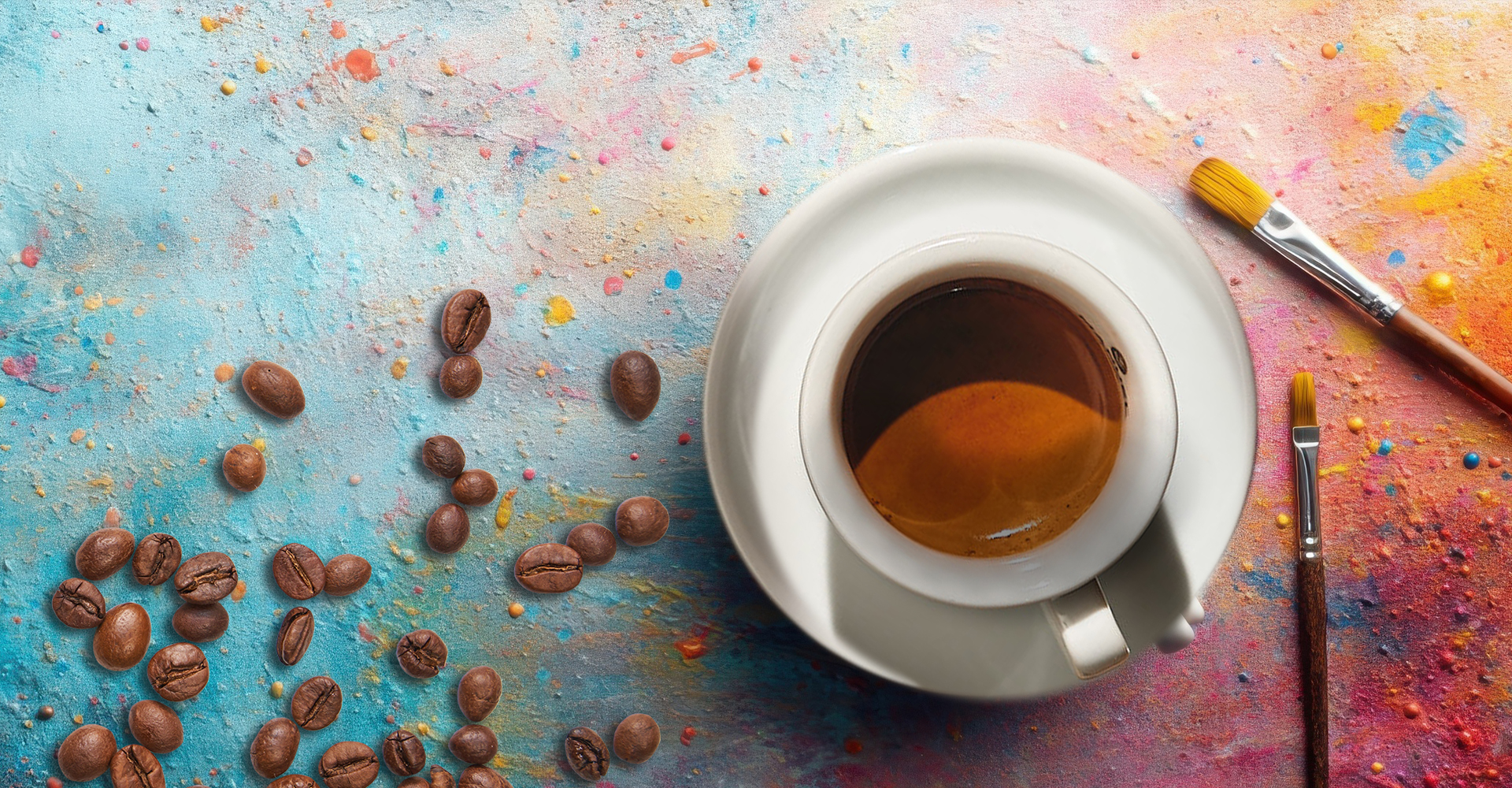
Art and coffee have more in common than you might imagine. They are born from a blend of technique and creativity, requiring care, passion, and attention to detail, and above all, they transform the ordinary into an extraordinary experience.
An ancient gesture, a constant inspiration.
For centuries, coffee has been a part of the daily lives of writers, musicians, painters, and thinkers. The first European coffeehouses were not simply establishments: they were true hotbeds of ideas, meeting places for artists and intellectuals, spaces for discussion and inspiration. From London to Vienna, from Paris to Naples, the steaming cup accompanied silently and was always present.
Inspiration, but not only that; in many cases, the drink itself becomes the protagonist of works of art such as paintings, photographs, and novels, as a symbol of a suspended moment, a creative pause, an internal dialogue. Subject of new forms of creativity: here are some of the most famous.

Coffee in Painting: Renoir’s “The Luncheon of the Boating Party.”
In the 19th century, coffee often appears in still lifes and scenes of everyday life. A famous example is Pierre-Auguste Renoir’s “The Luncheon of the Boating Party” (1881), where steaming cups can be glimpsed amid smiles and conversations. In that painting, coffee is a symbol of conviviality, of shared pleasure, of a break that unites people.
Coffee as told in literature: “Black Coffee” by Italo Calvino.
Coffee has always held a place of honor in literature, too. Italo Calvino, in a short story entitled “Black Coffee,” turns it into a true ritual, a pause that becomes an opportunity for reflection and poetry. The simplicity of the gesture transforms into pure imagination, where a steaming cup is imbued with subtle and profound meanings.
Coffee as told by literature: Coffee in de Chirico’s metaphysical paintings.
Giorgio de Chirico, a master of metaphysical art, often inserts elements of everyday life into his suspended and mysterious settings. In some of his still lifes, coffee cups appear alongside enigmatic objects. Espresso thus becomes an element of contrast between the real and the unreal, between the tangible and the dreamlike.
Coffee in Film: Jim Jarmusch’s “Coffee and Cigarettes.”
Among the most iconic cinematic works dedicated to coffee, Jim Jarmusch’s Coffee and Cigarettes (2003) stands out. A collection of black-and-white short films in which coffee becomes the common thread of surreal dialogues, existential reflections, and moments suspended in time. Smoking cups and slow conversations: coffee as a ritual, a break, and an excuse to talk about art, music, and life.
Coffee in Music: “Black Coffee.”
Coffee has also inspired many songs, becoming a metaphor for moods and atmospheres. One of the most famous is “Black Coffee,” made famous by Ella Fitzgerald and Sarah Vaughan. The song transforms black coffee into a symbol of solitude and melancholy, an accompaniment to long nights and deep thoughts. A perfect example of how an everyday gesture can become musical poetry.
And we cannot fail to mention the historical link between coffee and jazz: coffeehouses in the 1950s and 1960s, especially in America, were veritable temples of live music. The aroma of coffee mingled with improvised notes, creating unique atmospheres. Even today, drinking an espresso while listening to a saxophone solo evokes that intertwining of creativity, freedom, and sensory pleasure.

Adarte: a complete sensory experience.
This concise exploration of the parallels between coffee and art couldn’t fail to include one of Manuel Caffè’s iconic blends: Adarte. A blend of taste, aroma, warmth, and atmosphere, but also an invitation to reflection and, at the same time, conviviality.
100% Arabica, from select plantations and individually roasted single-origin beans, for a premium coffee with a sweet and enveloping flavor. Not just a blend, but a true creative statement. Adarte.