Patented in 1884 as a device for making espresso coffee, presented on the occasion of the General Exhibition at Valentino, born in the café of the Hotel Ligure, in Piazza Carlo Felice,
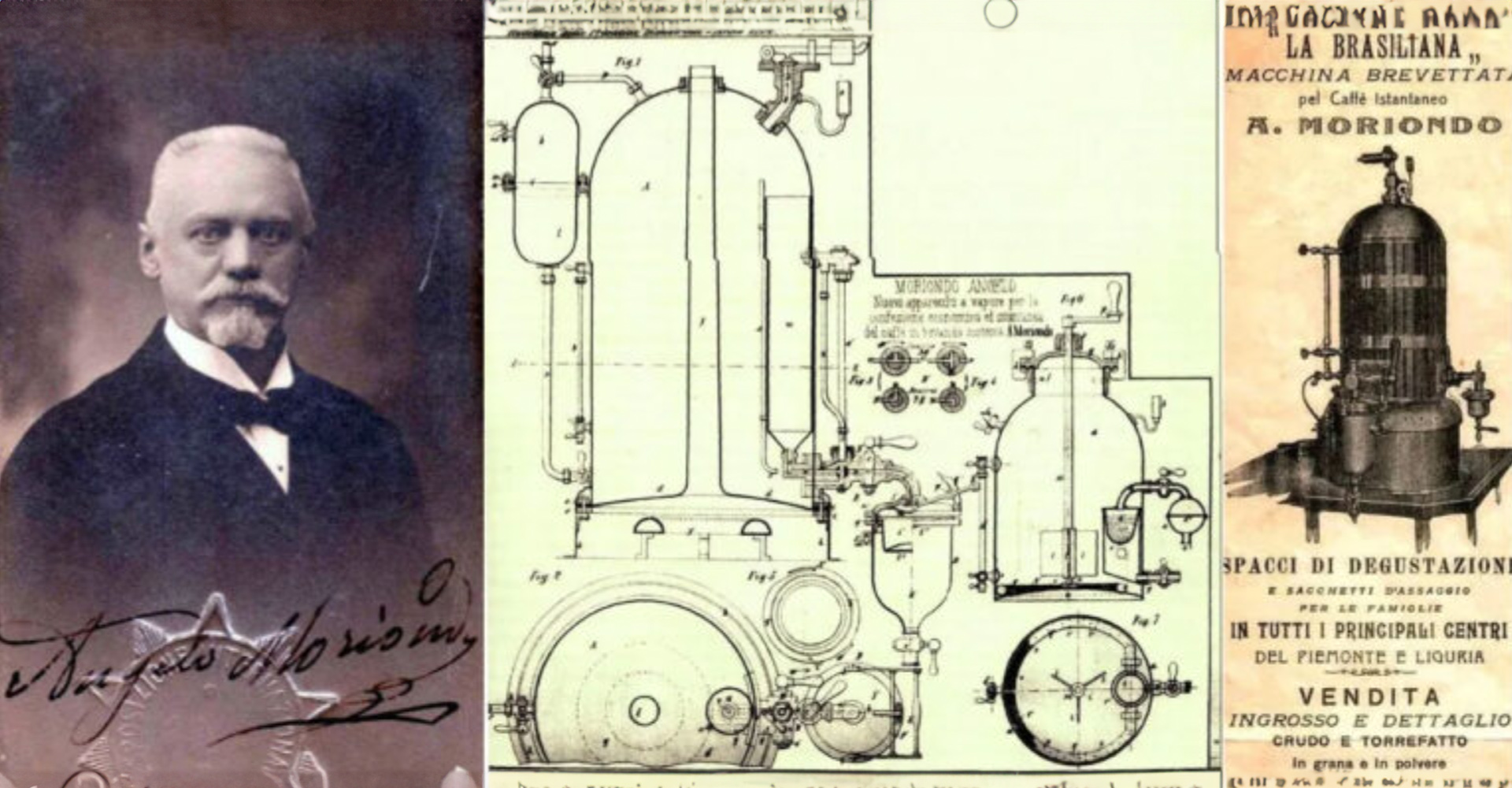
Since then it has been the subject of studies, variations and improvements to increase its functionality, but above all to perfect the final product. Our dear espresso coffee.
But how does a professional machine work?
In general, for the sake of simplicity, let’s say that the professional coffee machine pressurizes the water and pushes it through a chamber where the previously ground coffee is located. The water flows through a filter that has the task of letting only the liquid part pass, and here the coffee appears in our cup.
If we want to go into detail, and in this case we do, after the barista presses the dispensing button, in a handful of seconds the espresso machine brings the water to about 90°C at a pressure of 9 atm in such a way as to extract from just a few grams of powder the world of aromas and flavors that correspond to it, without giving way to too much caffeine.
Let’s see the phases.
First of all, the electric pump takes water from the hydraulic network, pressurizes it and pushes it to the heat exchanger which increases its temperature. The water is then taken to the dispensing unit where it comes into contact with the coffee.
The coffee is then dosed and compacted in the filter holder which, in turn, is attached to the dispensing group. This is where the crucial pre-infusion phase takes place.
Pre-infusion, which can only be achieved with professional coffee machines, allows the contact time of the coffee with the water to be extended so that the carbon dioxide is eliminated from its cells, facilitating its passage. Technically, this is percolation, i.e. the passage of water through the cells that form the coffee powder and releases all its aroma, flavor and organoleptic characteristics.
To be clear, only by doing so can the coffee maintain all its purity and it is the only way to obtain the creaminess that everyone recognizes as the founding note for a quality espresso.
If we want to go one step further, it goes without saying that each function of our machine corresponds to a “mechanical” component.

The water softener is the first component that we find connected between the water supply and the machine with a fundamental function. To obtain a good espresso it is essential that the water is as pure as possible, odorless, tasteless and colorless and the calcium and magnesium content of the water must be very limited. This is the task of the water softener, the filter that lowers the hardness of the water.
The boiler heats the water, bringing it to temperature thanks to contact with a heat source that, depending on the type of coffee machine used, can be an electric resistance or a gas burner.
The heat exchanger is the instrument that is located inside the boiler, immersed in hot water and steam, which allows the water to reach the temperature of 90°, necessary for extraction.
The brewing group is that part of the machine to which the filter holder is attached. It contains a thermosiphonic water recirculation system that keeps the temperature constant, preventing a drop in the temperature from damaging the quality of the final product.
The electric pump has the fundamental function of increasing the water pressure. When it comes out of the water supply, in fact, its pressure varies from 1 to 3 atmospheres, but to make it possible for it to pass through the ground coffee panel, 8 or 9 atmospheres are needed.
The picture is completed with the level regulator that serves to keep the temperature of the water in the boiler constant, and the solenoid valves that, instead, regulate the flow of water and steam. In the final phase of the path that leads to dispensing we have the shower heads that, through a round steel mesh, uniformly distribute the pressurized hot water through the coffee.
Next comes the filter holder (where the actual filter is inserted), separated from the brewing unit by a silicone rubber gasket that ensures its seal. The filter holder is equipped with a thermally insulated handle and spouts from which the coffee comes out.
Another very fundamental component must be added to the whole thing: periodic maintenance of the machine and its frequent cleaning, especially of the grinder-dispenser, filter holder, filter and steam wand.
Now that we know in detail the functions of all the components of a professional coffee machine, all that’s missing is the blend, and for that there’s Manuel Caffè. Professional, aromatic, irresistible, with the undisputed charm of someone who is capable of enclosing great quality in a single cup.